Made from scrap

Made from scrap
All's well

Followers

Total Pageviews

Showing posts with label drop spindling. Show all posts

Saturday, 9 April 2011

Birmingham and District Guild Weavers Spinners and Dyers - Colour Play Workshop

Today the Guild meeting was exactly what it said...Colour Play with Gillian Shepherd.  I got the chance to play with the biggest stash of yarn and fibre I have ever seen.  I am sure Gill should be in the Guinness Book of Records for the most stash squished into a car!  The morning began with a Powerpoint about colour theory.  The Colour Wheel, Primary, Secondary and Tertiary colours.  We also looked at tints and shades.  We explored analogous colours (those that are adjacent to each other on the colour wheel) and complimentary colours (those which are opposite each other on the colour wheel).  I can't even say analogous.  I am sure I will play with colour mixing and my little tin of water colours. 
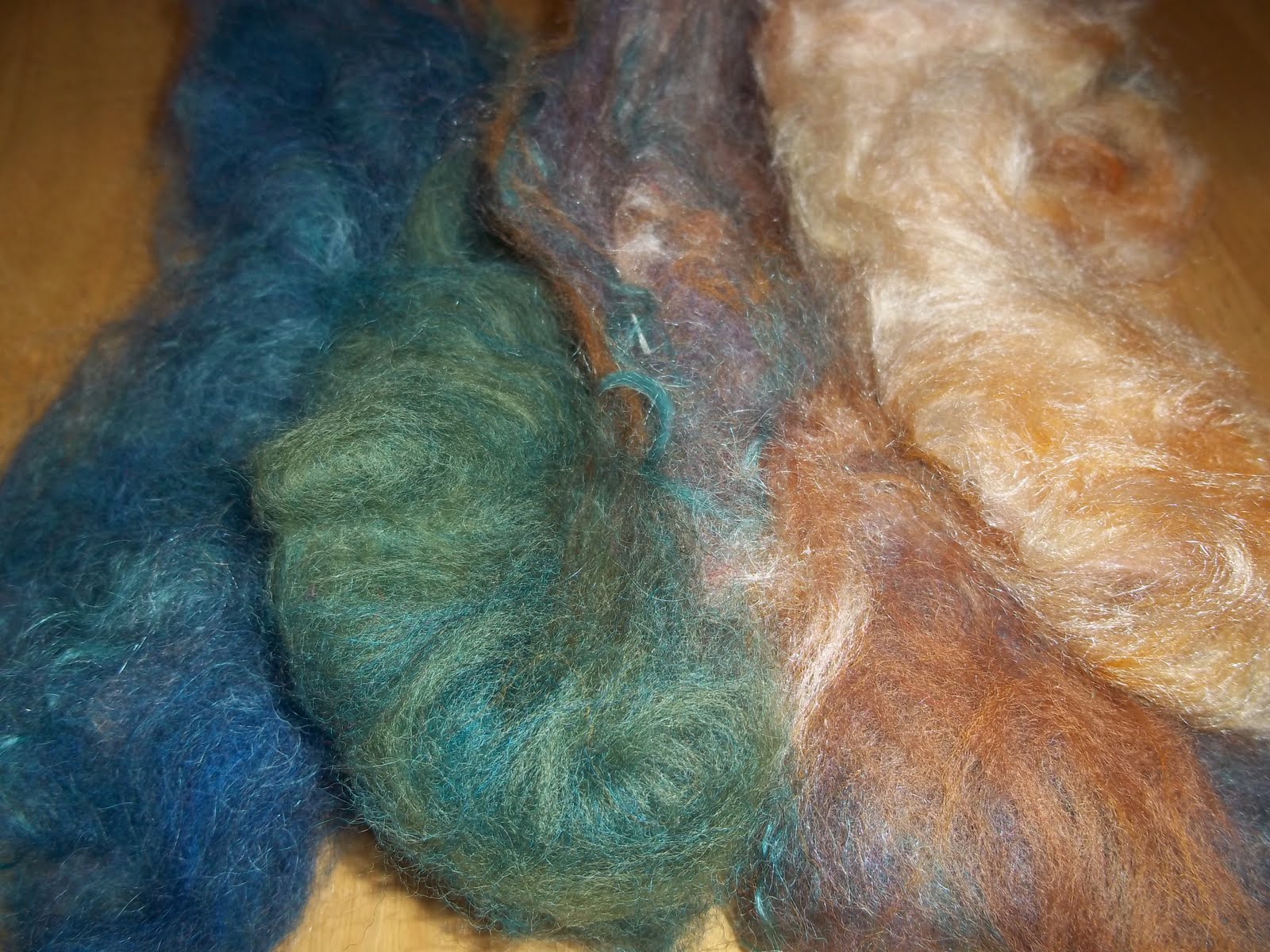
     We were given 'words' or 'phrases' to explore such as 'An Evening by the fire', 'The Beach', 'The rainy Canal', 'A moment of Anger', 'The Misty Morning',  'A Babies Bottom', 'The Naughty Dog', 'Victory' and 'The Lovely Duck'.  We each had one of these titles for the morning.  There were four 'Play Stations'  Knitting, Weaving, Spinning and carding and dying.  I played with hand carders and briefly with a spindle.  I hope the photograph of my fibre is screaming...The Lovely Duck at you!  My Mom had 'Victory'  I will see if she will let me photograph it tomorrow so I can show you.  We only had the pictures in our head to use and we were asked to pick three analogous colours and one complimentary to explore.  I really think I have inheritted my Dad's colour blindness! 
     I was thinking Mallard and tried to do my best to card 'The Lovely Duck'.  I used Green/blues or blue/greens with a bit of purple for the complimentary I used a bit of orangey brown.   See...
After the morning session we had lunch and then returned for a show and tell.  I didn't take photographs of other peoples work so it is a bit hard to tell without the show.  'The Naughty Dog' was interpretted in weaving, there were some Jack Russell colours, green grass and blood, as one of the member's dog had bitten her husband this week!  It was a dramatic textile.  'The Evening by the Fire' was interpreted on cotton using Dye crayons and Dye paint for a more vivid colour and some hand painted yarn was also made using 'An Evening by the Fire' colours.  I tried again to conquer my struggle with the spindle, but I was not Victorious.  My Mom's 'Victory' was a rather funky yarn with Reds,purply pinks, green and green Angelina sparkle.  Mom and I seemed to burn ourselves out with creativity and felt a bit peaky so we left early today.  Us creative/Arty types put our heart and soul into it!  I had to have a nap this afternoon and I bet my Mom did too!  Tomorrow I may spin my Lucky Ducky fibre and I also hope to capture 'Victory' to show you.

Saturday, 12 February 2011

Birmingham & District Guild of Weavers, Spinners and Dyers 12th February 2011

Today it was our monthly Guild meeting.  It was an Open Morning where members old and new share their crafts and experiences all washed down with tea and cake perfect.  (I took the plate of Love Heart Cookies).  This morning the room seemed a positive hive of activity. Experienced members were teaching newer members to spin on a wheel, they were experiencing the common issues for beginners 'Like patting your head and rubbing your tummy at the same time'.  Not put off they went home with a variety of fleece and fibre to experiment with, and will undoubtedly produce some unique lumpy, knobbly, springy yarns that will be much loved. 
There were also some members spinning on drop spindles.  The spindles were of all shapes and sizes, including distaffs.

I took along my Kiwi wheel and my Ashford Student Spindle.

I had more success today with my drop spindle, I practiced on a different spindle which I have to admit seemed easier to use than my spindle for 'Students', but with help and advice, finally I got it together and realise what it is I have to practice to spin a yarn on a drop spindle.  I am pleased that 'The Penny has finally dropped!'.  It is a good feeling to learn something new.  I will try and get the spindle full of singles and at the next meeting or two see if I can learn how to Navajo ply.
I am always fascinated to see Navajo plying on a drop spindle.

Others were weaving on square 'Weave It' Looms and inkle looms.


There was also the usual knitter nattering going on.  In all some beautiful work being created.

     In the afternoon there was a talk 'The History of String' by Ruth Gilbert.  This was an educational talk about the history, evidence and techniques for making twine, string and yarn. 
http://www.textileconservationcentre.co.uk/legacy/ruth-gilbert-mphil
There was an interesting slideshow of pictures and photographs to accompany the talk and a table with samples of various twines made from bark, grasses, plant roots and stems and also some modern twines and recycled plastic bag twine.  My favourite was a sample of a bag woven in New Guinea out of plant fibres.  Like the one below.

We looked at methods including twisting in the hand, spinning on a stick, spinning on a hooked stick, supported spindle, rolled on the thigh e.g Navajo, rotation of the spindle in the hand, grasped spindle, supported spindle - twirled in a dish and the use of the suspended spindle.  We considered  'Weaving is older than History', to weave there must have been yarn/ fibre that was handspun. The talk was certainly thought provoking.

I enjoy mooching through our Guild's Library and this month I borrowed two books:
Knitting Around by Elizabeth Zimmerman, I have been wanting to read Elizabeth Zimmerman for a while as I believe she is considered a controversial writer, by some a knitting Guru and by others patronising pain in the posterior.
Knitting with Dog Hair by Kendall Crolius and Ann Black Montgomery I am sure my dog produces more fibre annually than a sheep, I sweep and vacuum enough of the darn stuff daily!  When I groom her I can literally harvest it by the bag.

Monday, 7 February 2011

The Recycled Sari Yarn Industry


I have been doing some internet research into the production of Recycled Sari Silk Waste Yarn.

Why?
1) Because the yarn is beautiful.
2) I feel there is something exotic about Sari Silk.
3) I am fascinated about life and culture of India/Nepal.
4) Something beautiful created out of a recycled waste product has to be a good concept doesn't it?
5) A product that enables individuals to earn a living from craft skills is also good.
6) Supporting others to support themselves.
7) I am interested in spinning and working with additional fibres to wool.


Visually this yarn is impressive not only for the mixture of vivid, rich colours but also the sheen the silk gives off enhances the yarn and reflects the light.  I have read this is because of the prism shaped celullar structure of silk threads.  Silk is a protein fibre harvested from the silk worm. 

So how does this...
Get to this...
Then to this...
So I can make this...

A silk worm is not actually a worm, it is the larvae of a moth.  Silk has been Harvested for thousands of years and used to make the finest cloth.  The purest white silk is produced from silkworms raised on Mulberry leaves.  They 'spin' silk to form their cocoons.  These cocoons are then harvested and they need to be de-gummed to have a sticky resin removed with warm soapy water.
The degummed cocoons can then be spun into very fine thread.  They do not need to be combed or carded and are very easy to spin with.  Long rovings can be pulled from the mass and the indidvidual silk fibres are long, fine and lustrous.
Spinning silk to be woven in to Saris provides a living for many across india. 

Skills get passed on by traditional methods.  Many familys have simple spinning wheels and large weaving looms.

The cocoons are often dyed prior to spinning and some rich, vibrant colours are produced.
It take skilled work and many hours to produce some of the finer saris by hand.
As with many processess silk production creates waste.  The ends of the threads off the looms can be gathered and recycled.

This is known as throwsters waste and it can be spun to produce beautiful and unique yarns.

These yarns can then be made into a variety of Garments and items.